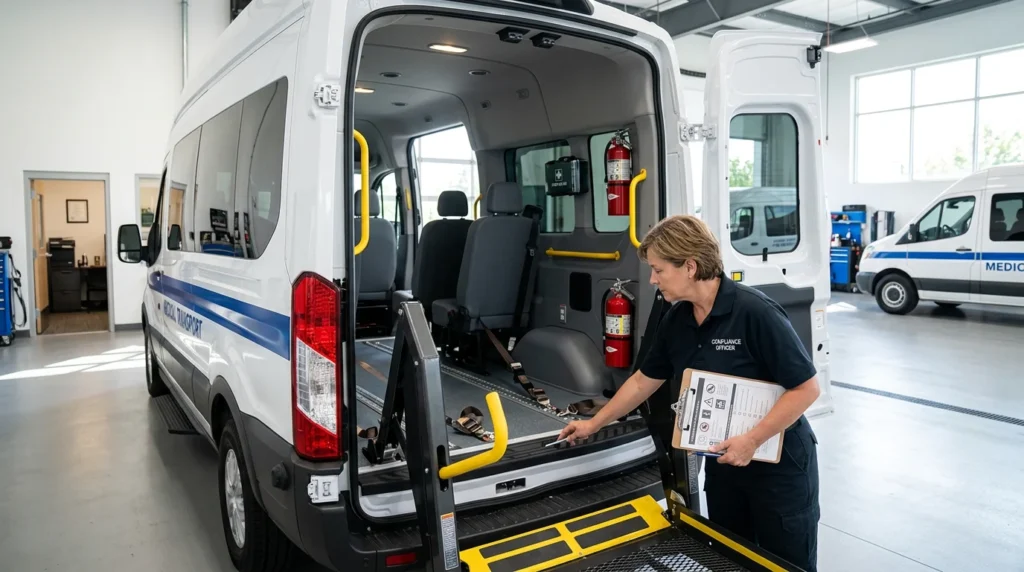
Quick answer: Long-distance medical transport is governed by a patchwork of state licensing rules (for wheelchair and stretcher/NEMT services), ambulance/EMS regulations when emergency-level care is involved, federal DOT/FMCSA rules if the operator qualifies as a commercial motor carrier, and HIPAA when protected health information is handled for a covered entity. Because requirements can change across state lines, confirm the provider’s license category, insurance, staffing, and safety practices for your exact route and care needs.
What’s Actually Regulated
Long-distance medical trips aren’t governed by one single rulebook. The requirements usually come from state health or transportation agencies, plus federal rules that apply to commercial vehicles and, in some cases, healthcare privacy. If you’re comparing providers, ask them to walk you through how they meet medical transport regulations for the type of service you need, not just the distance you’re traveling.
The biggest dividing line is the “level of care.” A wheelchair van trip, a non-emergency stretcher trip, and a higher-acuity medical transport can fall under different licensing and staffing expectations. Some trips are essentially mobility assistance with securement and safe driving; others require medical monitoring, oxygen management, or coordination with facilities. The more clinical the transport, the more oversight you should expect.
Which Rulebooks Usually Apply
State licensing (common for NEMT/wheelchair/stretcher): Many states license or permit non-emergency medical transportation (NEMT) providers, wheelchair van services, and non-emergency stretcher transport under health, EMS, or transportation departments. These programs often set minimum vehicle, driver, and operational standards and may require inspections or permits for each vehicle.
Ambulance/EMS rules (when medical care rises to that level): If the trip is an ambulance service or requires EMS-level staffing and interventions, state EMS/ambulance regulations typically apply (and may be stricter about medical direction, equipment, and clinical documentation).
DOT/FMCSA rules (when operating as a commercial motor carrier): If the company’s vehicles/operations meet the definition of a commercial motor carrier in interstate commerce, federal requirements can come into play (for example, driver qualification files, drug/alcohol testing programs, hours-of-service, and vehicle inspection/maintenance standards).
HIPAA (when PHI is handled for healthcare): HIPAA generally applies when a provider is a covered entity (like many healthcare providers) or a business associate handling protected health information on behalf of one. Even when HIPAA doesn’t strictly apply, good practice is to limit who gets trip details, diagnoses, medication lists, and discharge paperwork.
Key Compliance Areas Families Should Focus On
Regulations tend to cluster around a few practical areas that directly affect safety. Vehicle standards usually include maintenance, cleanliness, safe loading practices, and proper securement for wheelchairs or stretchers. Driver requirements often include background checks, training, and limits on impairment and distracted driving—plus the right class of license if the vehicle size or use triggers it.
For medical needs, match the transport to the patient’s risks. If the patient needs oxygen, has a high fall risk, has limited ability to reposition, or has cognitive impairment, you want a clear plan for monitoring, positioning, toileting breaks, and what happens if symptoms worsen en route. Ask how the provider limits access to patient information and how paperwork is stored and transmitted.
Vetting Checklist and Documents You Can Request
Use a concrete checklist so you’re comparing apples to apples. Here are questions that usually surface compliance gaps quickly:
1) What license category do you operate under for this trip (wheelchair/NEMT, stretcher, ambulance/EMS), and what is the license number and issuing state agency? 2) If we cross state lines, how are you authorized to operate for pickup and drop-off locations? 3) Who will be on the vehicle (driver only, attendant, EMT/paramedic, nurse), and what training is relevant to this patient’s needs (oxygen handling, transfer techniques, dementia safety, pressure-injury prevention)? 4) What equipment will be onboard (stretcher type, wheelchair tie-downs, ramps/lift, oxygen storage, suction/AED if applicable), and what’s your backup plan if equipment fails? 5) What is your policy for rest breaks, repositioning, meals, and toileting on trips that run many hours? 6) What are your procedures if the patient’s condition changes (who is contacted, when do you divert to an ER, do you coordinate with medical control if applicable)? 7) What insurance do you carry, and what are the policy limits and effective dates? 8) How do you protect patient information and limit who can receive updates?
Documents families can reasonably request (or ask to view) include: the provider’s current license or permit (showing type, number, and expiration), a certificate of insurance (COI) naming the insured and policy dates, a driver qualification/training summary for the crew assigned (not private personal data), and—where appropriate—recent vehicle inspection/maintenance records or a statement of preventive maintenance and daily inspection practices. For interstate commercial operations, you can also ask for the company’s USDOT number and verify it through FMCSA’s SAFER system.
For authoritative lookups, check your state’s health/EMS department website for “ambulance licensing” or “NEMT provider licensing” pages (many have public rosters or contact numbers). For federal carrier status, use FMCSA resources like the SAFER Company Snapshot and the National Registry of Certified Medical Examiners (for driver medical certification context). For privacy basics, search the U.S. Department of Health & Human Services (HHS) site for the HIPAA “Summary of the Privacy Rule” and “business associate” explanations.
Contact multiple providers to compare licensing, insurance, staffing, and route planning for your care level and itinerary. Managed Medical Transport, Inc.