Quick answer: You usually need a repair if the frame is sound and problems are localized—like a few soft boards, loose railings, or corrosion limited to surface hardware. Replacement (or a major rebuild) is more likely when joists, beams, posts, or the ledger connection are deteriorated, separating, or underbuilt. A hands-on inspection of the ledger/flashing, post bases, and stair framing determines which path is safer and more cost-effective.
What a Deck Repair Typically Covers
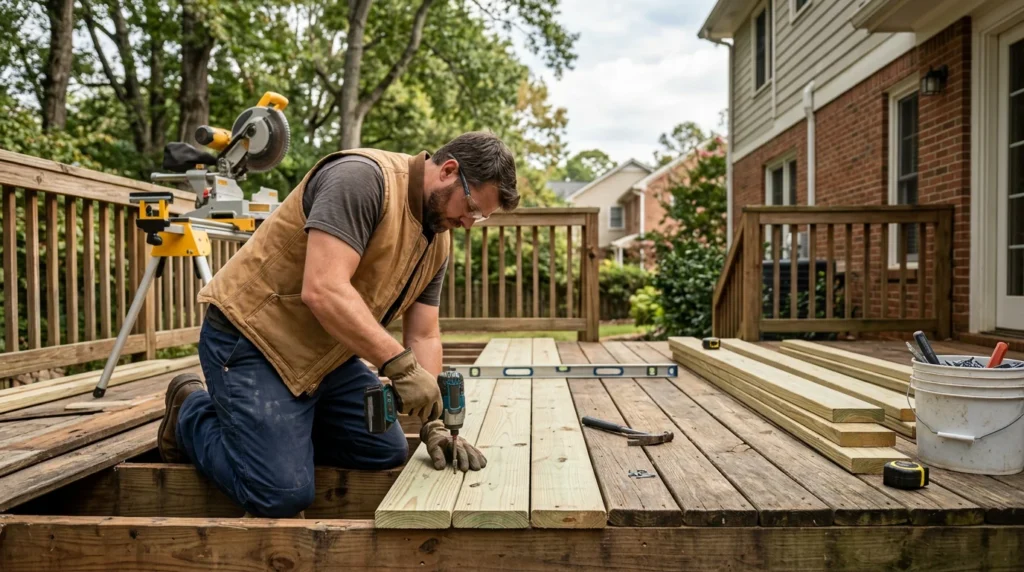
Most deck repairs focus on restoring safety and stopping damage from spreading: swapping out rotted or split deck boards, tightening or rebuilding loose railings, re-securing stairs, and correcting wobbly sections. In our climate, it’s common for shaded decks to stay damp longer, which can accelerate decay where water gets trapped against wood or hardware.
A good deck repair Athens GA visit usually starts with checking the parts you can’t easily see from the top—joists, beams, post bases, and the ledger board where the deck attaches to the house. If those are solid, targeted repairs can often extend the deck’s usable life without rebuilding the whole structure.
Repairs also commonly include upgrading connectors (joist hangers, post caps/bases), replacing rusted fasteners with exterior-rated hardware, and improving water-shedding details so the same rot doesn’t come right back.
Stop and Call a Pro Now
Block access and schedule an inspection right away if any of these safety thresholds show up: the railing moves more than a little when you shake it, stair stringers feel spongy or show rot near the bottom, the ledger looks like it’s pulling away from the house, or post bases are decayed/loose where they meet concrete or soil.
Immediate next steps are simple: keep people off the deck, don’t store heavy items on it (grills, planters, stacked lumber), and avoid “testing” weak spots by bouncing or jumping. If you must cross the deck to reach a door, do it one person at a time and stay near the house side until it’s inspected.
A Simple Inspection Checklist You Can Do in 10 Minutes
You don’t need special tools to get useful clues—just a flashlight and a screwdriver or awl. Probe where decks commonly fail: joist ends where they meet the ledger, the beam-to-post interface, post bases, and stair stringers (especially within a foot or so of grade and at any cut ends).
Use the “deep sink” test as a typical rule of thumb: if the tip sinks in easily more than about 1/4 inch into framing members (joists, beams, posts, stringers) or the wood crushes and flakes instead of resisting, framing replacement is likely in that area. If only a few deck boards are soft while the joists beneath feel firm and dry, localized board replacement is often reasonable.
Also look for common warning signs: dark staining around fasteners, mushroomy or crumbly wood fibers, rusted-through connectors, and cracks that run through the full thickness of a member. Take photos as you go; they help a contractor quickly understand what you’re seeing.
Local Factors in Athens That Can Tip the Decision
In Athens and the surrounding area, humidity, shade from mature trees, and frequent wet/dry cycles commonly keep decks damp longer—especially on north-facing sides or where airflow under the deck is blocked. That makes rot at post bases, stair bottoms, and joist ends more likely than problems limited to the top surface.
Older housing stock can also mean you’ll run into ledger and flashing details that don’t match modern best practices. Current guidance for deck ledger attachment, flashing, and connections is covered in resources like the American Wood Council’s DCA 6 and the International Residential Code (IRC). If your deck-to-house connection is questionable, a rebuild that corrects the ledger, flashing, and fastening is often safer than repeated patch repairs.
Permits and inspections can come into play for larger rebuilds, changes to size/height, or structural work. A straightforward board swap may not trigger the same requirements, but a structural rebuild often does, and that process can influence timing and scope. For a local assessment and a clear repair-or-rebuild plan, Tipton’s Fine-Tuned Carpentry can help.