Quick answer: Choose a place you can realistically get to and live in every day: confirm the actual walking time to your main building, how parking works, and whether the lease is per-person (individual) or per-unit. Prioritize privacy in the floor plan, verify what’s included in utilities, and read the rules on guests, subletting, and early termination. Tour with a checklist and get answers in writing.
Start With Location And Your Day-To-Day Routine
“Near campus” can mean very different things in real life. Before you tour, map your weekly rhythm: early classes, late labs, campus events, and how often you’ll run back and forth. Don’t rely on a leasing office’s description—open Google Maps and check the walking time to your main building, then check it again at night to see the route you’d actually take.
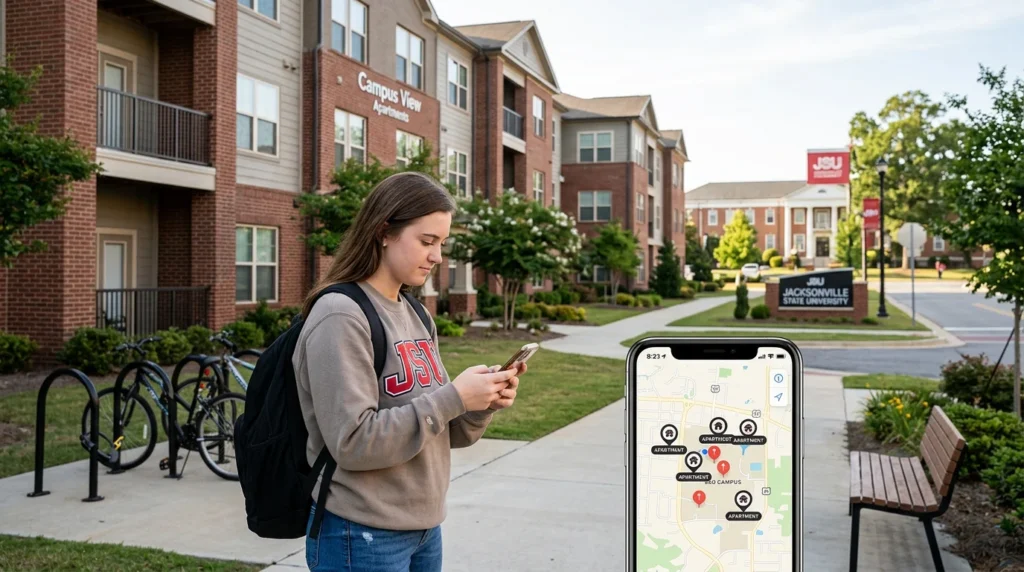
If you’re specifically comparing apartments near JSU campus Jacksonville AL, verify what “close” means for you: your most common academic building, the library, and where you’ll study. If a property claims “walking distance,” ask them to point to the exact campus entrance they mean and walk it during your tour.
Also do a quick reality check on safety and access: ask how you enter after hours, where the well-lit paths are, and whether you’ll be comfortable walking back after evening activities.
Use This Tour Checklist To Compare Apples To Apples
Bring the same checklist to every tour and write the answers down. Small policy differences can change your costs and your stress level more than the floor plan photos.
- Exact walk time: Google Maps walk time from the front door to your main building (check daytime and after dark routes).
- Parking policy/cost: Where do residents park, is it assigned, and what does it cost (if anything)? Ask what happens during game days or busy weekends.
- Roommate matching: If you don’t have roommates lined up, ask whether matching is offered and what factors they use (sleep schedule, cleanliness, pets, etc.).
- Utility setup/caps: What utilities are in your name vs. included, and are there usage caps or extra charges?
- Guest policy: How many nights can a guest stay, and are there quiet hours or check-in rules?
- Maintenance response process: How do you submit requests, what counts as an emergency, and how are after-hours issues handled?
- Security/access details: If there’s a gate, ask if it’s staffed or key-fob/code controlled and how often it’s down; if there isn’t, ask what access controls exist.
- Renewal timeline: When do renewals open, when do rates change, and what’s the deadline to avoid going month-to-month or losing your spot?
Ask for answers in writing (email is fine). If the staff won’t put key policies in writing, treat that as a red flag.
Pick A Floor Plan That Protects Your Privacy
Your floor plan is where student housing can either make life easy or create daily friction. If you like having your own space, prioritize student apartments with private bedrooms. A common student setup is a 4 bedroom / 4 bathroom layout, which can reduce bathroom conflicts while still giving you roommates.
During tours, verify details instead of assuming: stand in the bedroom and check if you can fit your desk setup; open closets and kitchen cabinets to judge storage; and ask whether bedroom doors lock. If you’re counting on on-site amenities, confirm the fitness center hours fit your schedule and ask what happens during holidays or maintenance closures.
If you’re choosing with friends, don’t just agree on the rent—agree on expectations. Private bedrooms help, but shared spaces still require clear ground rules about guests, cleaning, and quiet hours.
Avoid Student-Lease Pitfalls Before You Sign
Lease structure is where students get burned. “Individual leases” (sometimes called by-the-bed leasing) usually means you’re responsible for your own portion. A per-unit lease can be very different: many include joint-and-several liability, meaning if a roommate doesn’t pay, the landlord can pursue the remaining roommates for the full amount. Ask directly: “Is this lease per person or per unit, and do I have joint-and-several liability?”
Other common pitfalls to ask about up front: subletting rules (can you sublet if you study abroad or transfer?), early termination fees (what does it cost to leave), guarantor requirements (is a parent/guardian required, and what are they guaranteeing), and assignment fees (what you pay to change roommates or transfer the lease). Also ask what happens if a roommate is evicted or moves out mid-lease.
Get clarity on money details in plain language: exactly what’s due at signing, what’s due at move-in, how utilities are billed, and how damages are handled at move-out (per bedroom or shared). If you want help asking the right questions and comparing student-focused options near campus, The Pointe at JSU is a good place to start.