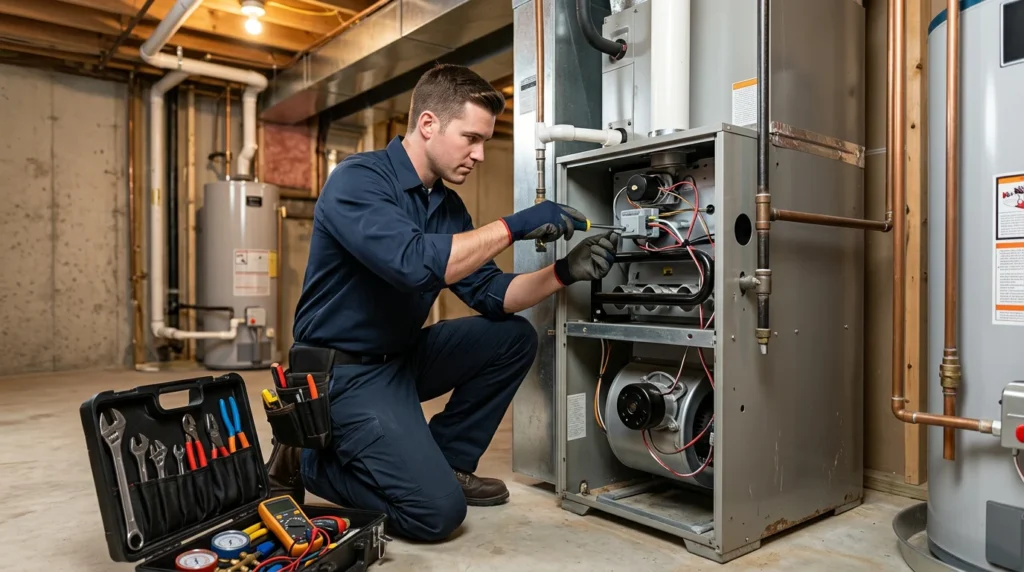
Quick answer: You likely need a repair if your system won’t stay running, blows cool air, makes new banging or squealing noises, trips the breaker, or you smell gas or persistent burning odors. A tune-up fits when it still runs reliably but seems less efficient, cycles more than usual, or hasn’t been serviced in a year or two. Any gas odor or suspected fume issue should be checked immediately.
Quick Signs It’s a Repair, Not Routine Maintenance
Decision tree: Stop and call today if you smell gas, see soot, notice a strong persistent burning smell, or anyone in the home has headaches/nausea that seem tied to the system running. Schedule service soon if it starts and stops every few minutes, won’t stay running, suddenly makes banging/squealing/scraping noises, or repeatedly trips a breaker. Try these safe checks first if it simply isn’t turning on and you haven’t checked power, settings, or the filter yet.
If it cuts out mid-cycle, the thermostat calls but nothing happens, or it short-cycles, that points to a component or safety-control problem rather than simple cleaning. Common culprits include a dirty flame sensor, failing igniter, weak blower capacitor, a clogged condensate drain on high-efficiency units, or a limit switch tripping from restricted airflow.
If you’re trying to get someone out for furnace repair Bethlehem GA, treat any gas smell or suspected fume issue as urgent and shut the system off until it’s inspected. Noise changes are another repair clue: metallic scraping can point to a blower wheel issue, while a loud boom at startup can indicate delayed ignition.
What a Tune-Up Usually Fixes (and What It Can’t)
A tune-up is meant to restore normal operation and efficiency, not to revive a failing part. Typical maintenance includes cleaning the burner area, checking ignition and flame quality, testing safety switches, verifying temperature rise, inspecting the filter and blower compartment, and confirming the venting looks sound.
Maintenance can solve issues caused by dirt, minor misadjustments, or restricted airflow. It usually won’t fix a cracked heat exchanger, a failing inducer motor, a weak blower motor, or a control board that’s intermittently dropping out. If the system runs, but you’re seeing steadily worsening performance or repeated lockouts, you’re likely past tune-up territory.
Regional note (general): around North Georgia, mild but damp winter weather can contribute to condensate drain and trap issues on high-efficiency equipment if drainage is marginal or a line is partially blocked. That’s not unique to any one brand or installer—it’s a common “water management” trouble spot to have checked during service.
A Simple Homeowner Checklist Before You Call
You can rule out a few basics safely. Confirm the thermostat is set correctly and the setpoint is above room temperature. Replace a clogged filter if you have one on hand; a severely dirty filter can overheat equipment and trip a safety limit. Make sure supply registers are open and return grilles aren’t blocked by furniture.
Check the breaker and the equipment power switch (often mounted on or near the unit). If you have high-efficiency equipment, look for a full drain line or a wet area around the condensate trap. If the system keeps tripping the breaker, don’t keep resetting it—repeated trips can point to an electrical fault or motor problem.
Avoid DIY on gas components. Don’t adjust gas valves, bypass safety switches, or tape vent pipes. Those steps can create serious hazards and make a professional diagnosis harder.
What to Expect From a Professional Repair Visit
Use this checklist to evaluate any contractor’s approach:
Core checks (should be routine): confirm the complaint and observe a full run cycle; inspect filter, blower compartment, and obvious airflow restrictions; verify temperature rise across the unit; inspect venting and intake piping for obvious blockage or disconnection; check safety controls and error codes; test key electrical components (capacitors, motors, switches) as applicable.
May include depending on system: combustion analysis and a carbon monoxide check where applicable; draft/vent pressure checks; static pressure and airflow measurements to spot duct restrictions; condensate trap/drain inspection and clearing on high-efficiency equipment; ignition and flame-sensing microamp testing; refrigerant-side checks on dual-fuel or packaged systems where applicable.
If you want a local team to diagnose the issue and get things running safely, Billy Butler HVAC is a straightforward place to start.