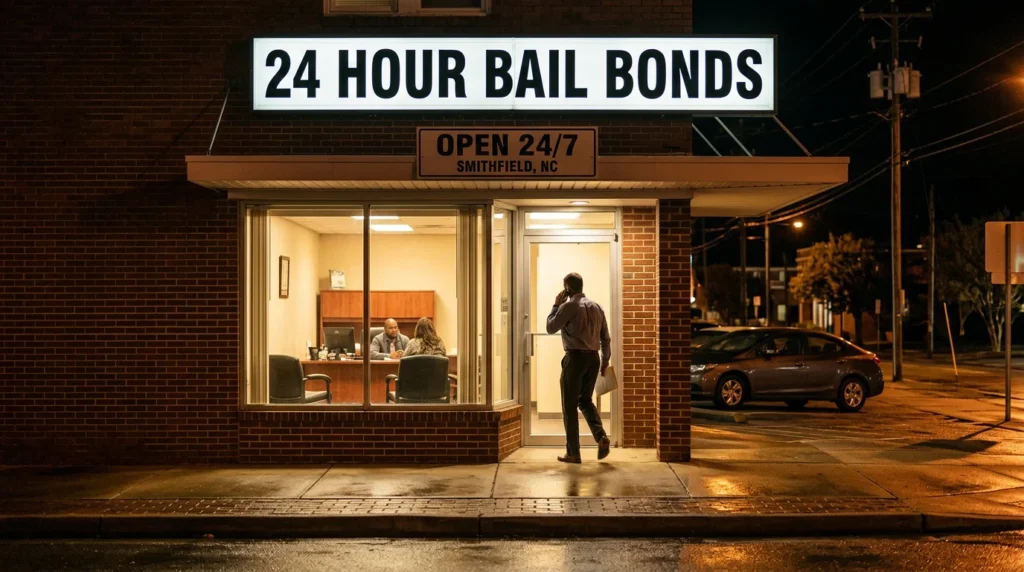
Quick answer: A 24-hour bail bond service can help you start the release process any time—nights, weekends, and holidays—by collecting booking details, confirming whether a bond has been set, and arranging paperwork and payment. A bondsman posts a surety bond with the court, and the jail can release the person once processing is complete. You’ll usually need identification, the defendant’s details, and sometimes collateral, depending on the bond and circumstances.
What You Can Do Right Away After an Arrest
If someone is arrested in Smithfield/Johnston County, the fastest first step is to get the person’s full legal name, date of birth, and where they’re being held (often the Johnston County Detention Center, but transfers can happen). Ask for the booking number if you can get it. With those details, a bondsman can check whether a bond has been set, confirm the listed charge(s), and tell you what’s needed to move forward with 24 hour bail bonds Smithfield NC service.
Here’s a typical after-hours sequence in Johnston County, without promising exact timing: arrest → initial booking → appearance before a magistrate (or bond set through the system) → bond amount/conditions entered → bondsman paperwork and payment arranged → bond posted/accepted → jail discharge processing and release. The jail may confirm that a person is in custody and basic custody status, but they often won’t give detailed case facts over the phone, and they generally can’t guarantee a release time.
Expect a few practical questions: Do you know the court date? Is there a “hold” from another county? Was the person already on probation? Any of those can delay release even after bond is posted, depending on the charge and any holds. A good next move is to avoid calling the jail repeatedly for timing—release speed is usually driven by staffing, shift changes, and how quickly the jail finishes intake and discharge paperwork.
What You’ll Need to Start a Bail Bond
Most bail bond calls go smoother if you gather a few basics first: the defendant’s full name, approximate age or date of birth, the jail location, and the charges if you know them. If bond has been set, the exact bond amount matters because it affects the bond fee and whether collateral may be requested.
You should also be ready to discuss employment, residency, and ties to the area. These details help the bondsman assess risk and decide if collateral makes sense. Collateral isn’t required in every case, but it can come up with higher bonds, limited local ties, or a history of missed court.
If collateral is needed, it’s commonly something with clear ownership and value—like a vehicle title or a real estate interest. Ask what documentation is required and how the collateral is returned. Get those terms in writing so everyone understands the conditions for return of collateral after the case is resolved.
How Release Timing Really Works
Posting a bond doesn’t mean the door opens immediately. After the bond is accepted, the jail still has to run internal checks, confirm there are no additional holds, and complete discharge steps. Many people are surprised that release can take a few hours, and it can take longer during busy periods or overnight staffing.
Delays often come from issues like: the court hasn’t entered the bond yet, the defendant has multiple charges with separate bonds, a probation hold is placed, or another agency has a detainer. If release seems stalled, ask the bondsman what status they can verify (for example, bond accepted vs. discharge in progress) so you’re not guessing.
Plan transportation and keep your phone available. Once the jail processes discharge, pickup windows can be unpredictable, and missing a call can add unnecessary time.
When to Call a Lawyer and When Bail May Not Be Available
Call a lawyer right away if the person is facing a serious felony, there’s an allegation of violence, there are protective-order/no-contact issues, or the case involves complex conditions that could be easy to violate. Legal advice also matters if you’re unsure about the consequences of signing as indemnitor or if there’s a risk of new charges based on contact with an alleged victim or witness.
Bail may be delayed or not available in some situations, depending on the charge and court decisions. Common examples include probation/parole violations with an active hold, out-of-county or out-of-state warrants, immigration detainers, or cases where a judge orders the person held without bond (or requires a hearing before bond can be set). Even when a bond amount exists, release can still be blocked until holds are cleared.
If you’re trying to help someone get released in Johnston County, contact a licensed bail agent for the exact requirements in your case.