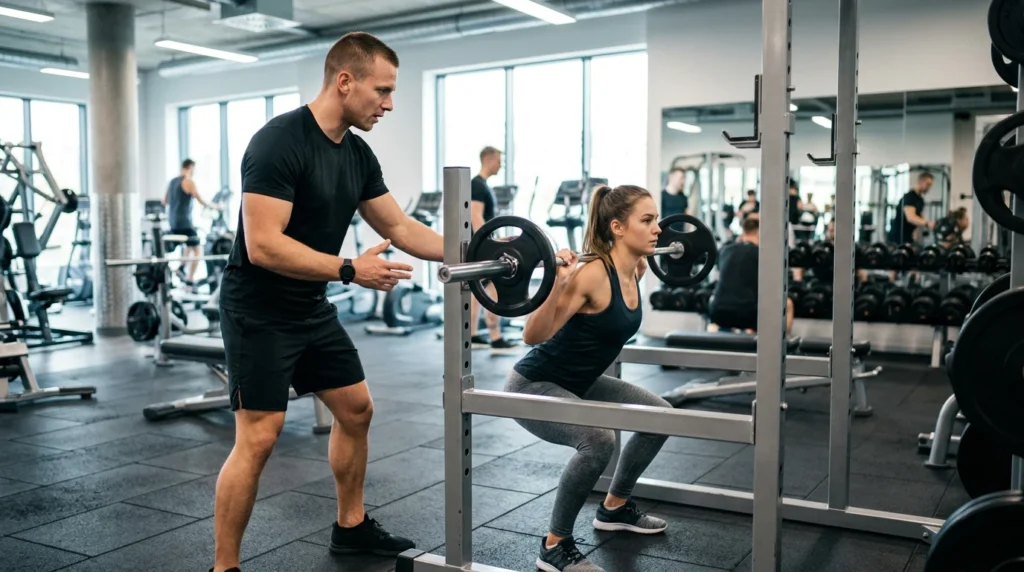
Quick answer: You can train on your own if you’re consistent, pain-free, and making steady progress with a plan you can repeat. A fitness trainer tends to help most when you feel stuck, keep getting minor niggles, aren’t sure how to structure sessions, or need accountability that changes your weekly habits. The right coach matches training to your goals, equipment, schedule, and recovery so improvements are safer and easier to track.
What A Fitness Trainer Actually Does
A good Fitness Trainer does more than count reps. They translate your goal (fat loss, strength, muscle gain, better posture, fitness for sport, or simply feeling less stiff) into a plan you can follow, then adjust it as your body responds. That usually includes exercise selection, technique coaching, progression, and realistic weekly targets.
Expect them to watch how you move and spot the small things you can’t see yourself: knee tracking in a squat, rib flare in a press, shoulder position during rows, or how your hips shift under load. Those details can be the difference between training that feels better over time and training that slowly irritates a joint.
They also handle the “boring but effective” parts: warm-ups that match your session, rest times, load choices, and a progression method (adding reps, weight, sets, or difficulty). If your plan lives only in your head, coaching turns it into something repeatable.
A Quick 6-Question Self-Assessment
Answer these with a simple yes/no. Then use the outcomes below.
1) Can you train 2–3 times per week for the next 8 weeks without guessing what to do each session?
2) Do you have a clear progression plan (how you’ll add reps/weight/sets) and a way to track it?
3) Is your technique solid on the basics you’re doing (you can repeat the same form under mild fatigue)?
4) Are you currently free of pain, or only dealing with mild soreness that settles within a day or two?
5) Have you been progressing in at least one measurable way in the last 4–6 weeks (reps, load, distance, pace, or consistency)?
6) Are you able to stick to training despite work, travel time, and family commitments?
Outcomes: If you answered “yes” to 1, 2, 4, and 6, train solo for now. If you answered “yes” to 1 and 6 but “no” to 2 or 5, buy a reputable program and run it for 8–12 weeks. If you answered “no” to 3 (or you’re unsure), book 1–3 technique sessions to clean up form and get a plan. If you answered “no” to 6 (consistency) or you keep answering “no” to 2 and 5 repeatedly, ongoing coaching is likely the best fit.
Pain, Niggles, And Red Flags
Minor aches can sometimes be solved with coaching: adjusting range of motion, changing exercise selection, reducing load, improving warm-ups, or spacing hard sessions more sensibly. Common examples include a shoulder pinch during pressing, front-of-knee discomfort in deep squats, or low-back tightness after hinging—issues that often improve when technique and training volume are managed better.
Some symptoms need medical assessment before you try to “train through” them. Seek professional medical help if you notice numbness or tingling, pain that radiates down an arm or leg, sudden swelling, visible deformity, a joint that feels unstable or gives way, loss of strength that comes on quickly, fever, unexplained weight loss, or pain that wakes you at night and doesn’t settle. A trainer can help you modify training, but they shouldn’t diagnose injuries.
If you’re unsure, a cautious approach is to pause aggravating movements, get the red flags checked, then return with a scaled plan and clearer limits.
East London Realities That Affect The Decision
In East London, the practical side often decides more than motivation. Travel time to a gym or studio can make or break consistency, especially around peak commuting hours and busy high streets. If getting to a session adds 40–60 minutes round trip, many people adhere better to a shorter home session or a gym that’s genuinely on the way.
Equipment constraints matter too. At home, many setups are limited to adjustable dumbbells, resistance bands, a mat, and maybe a pull-up bar. That can work well for general fitness, but it can slow strength progression if you don’t have heavier loads. Local gyms vary widely in what they offer—some are crowded at peak times, some have limited squat racks, and some have better space for technique work—so your plan should match what you can reliably access.
If you decide to hire a trainer, book a consult and ask: how will you progress over the next 4–8 weeks, how will sessions adapt to your available equipment and travel time, what’s the plan when you miss a week, and how you’ll handle pain vs. red-flag symptoms. KBPT Personal Training East London